

As we wrap up 2025, I wanted to share a final piece reflecting on my journey in Business Analysis and MIS. This year has been about growth, and what better way to close it than discussing the intersection of MVP and clarity? Thank you for being part of my journey this year. See you in 2026, with more insights, experiments, and reflections on building meaningful products. (P.S. If the calendar flipped before you got here, consider this a tiny MVP: a minimal yet meaningful wish for your 2026!)
MVP (Minimum Viable Product) is an approach that aims to deliver a product to users at the earliest possible stage with minimum effort and minimum features. The core objective is not to make the product perfect, but to test whether it is on the right track by collecting early user feedback.
In practice, however, MVP is often reduced to the idea of a “first working version.” This leads to projects being released under the name of MVP despite not offering a clear solution to any specific problem.
The real value of an MVP lies in whether it genuinely addresses a problem and produces a solution. If the product does not serve a clear purpose—or in other words, does not solve a real problem—the feedback collected from users will inevitably be weak or misleading. In such cases, the development team will struggle to interpret feedback correctly, increasing the risk of future product iterations drifting away from actual market needs.
For this reason, it is more accurate to think of an MVP not merely as a minimum-featured first release, but as a minimum product that delivers a solution. So what is the key element that transforms an MVP from an unfinished product into a problem-solving one? This is where requirements definition and requirements analysis come into play.
What Is Requirements Analysis?#
Requirements analysis is the process of examining, evaluating, and documenting the requirements identified during the requirements elicitation phase. When broken down conceptually, the idea becomes clearer: a requirement represents a desired feature or capability of a product, while analysis refers to evaluating and documenting these features. In product development, requirements analysis plays a critical role in understanding stakeholder needs.
The main objectives of requirements analysis include:
- First and foremost, understanding users’ needs and expectations.
- Since requirements are often gathered from multiple sources, inconsistencies and conflicts may arise. Requirements analysis helps identify and resolve these contradictions.
- User feedback may result in numerous requirements. Requirements analysis enables these to be prioritized.
- Requirements may need to be grouped and structured under different categories. Requirements analysis supports proper classification and organization.
The Relationship Between MVP and Requirements Analysis#
At first glance, MVP and requirements analysis may appear to be unrelated—or even contradictory—concepts. MVP focuses on minimum effort and minimum functionality, while requirements analysis may seem to expand scope. In reality, the opposite is true.
Requirements analysis allows an MVP to focus on a single, well-defined point. Which features are most demanded by users? Which features are desirable but not critical for the MVP? Why do users want to use the product? What problems does the product aim to solve? Answers to these questions can only be identified through a well-executed requirements analysis, enabling the MVP to align closely with real market needs.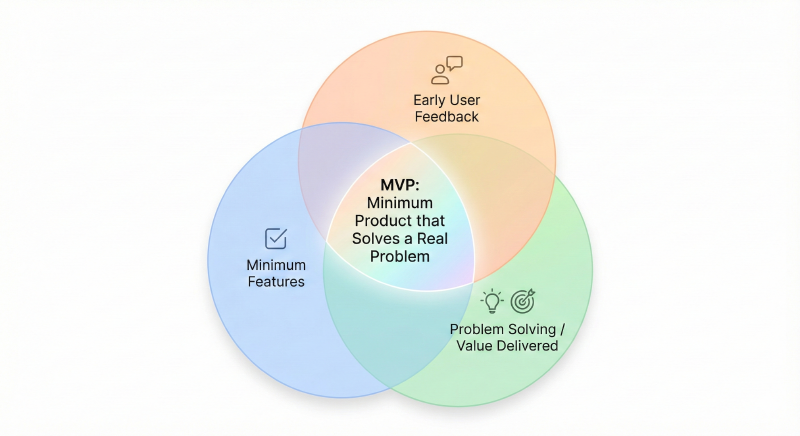
Why Does an MVP That Doesn’t Solve a Problem Fail to Generate Feedback?#
Let’s consider a simple example. Imagine releasing an MVP of a personal finance application designed to simplify expense tracking. The first version only allows users to add income and expenses. However, because the actual needs of the target audience were not thoroughly analyzed, users do not find the application any different from existing alternatives. As a result, the team receives either vague or directionless feedback. Without a clearly defined problem, user feedback becomes insufficient to drive meaningful product improvement.
At the root of this issue is often not technical inadequacy, but poorly defined requirements at the beginning of the product development process. If the target problem and user segment are not clearly identified during the MVP phase, the feedback collected will naturally be scattered and unfocused. Had requirements analysis been conducted properly from the start, it would have been clearer which features should be included in the MVP—and which should not.
Let’s examine the example in more detail:
- What users want: Detailed reporting, automatic categorization, regular import/export options.
- What the MVP offers: Income entry / Expense entry.
- The actual problem users face: Existing personal finance applications on the market lack the detailed reporting features mentioned above.
- Does the MVP solve this problem? No. Because requirements analysis was not performed, the team did not fully understand user needs. As a result, yet another undifferentiated personal finance application was released.
- What should have happened: A requirements analysis conducted before the MVP phase should have identified user needs and priorities. The MVP should then have been designed based on these findings, delivering a solution that genuinely addresses the user’s problem. This would have led to more focused feedback, making it easier to define future iterations and the product roadmap.
Conclusion#
The success of an MVP is not measured by how few features it has, but by which problem it solves. MVPs developed without requirements analysis tend to miss real user needs, resulting in vague and unfocused feedback. The outcome for the development team is uncertainty.
Rather than viewing requirements analysis as a time-consuming activity that broadens scope, it should be seen as a guiding tool that defines the right direction for MVP focus.